Bay Area ADU permit timelines in spring 2026: which cities are actually fastest
The state's 60-day rule is on the books. Actual processing across San Jose, Sunnyvale, Palo Alto, Mountain View, and Cupertino tells a different story. Real timelines from spring 2026 active permits.
I had a Cupertino homeowner call me last Friday genuinely upset. He'd filed his ADU permit in mid-January, expecting the state's 60-day approval clock to bring him final approval by mid-March. He'd just gotten his second round of corrections back from plan check, and his target ground-break date had slipped from April to mid-July. The plan checker said "we're working through the queue."
I've been managing ADUs across the Bay Area for 12 years, with 150-plus units under management between San Jose, Sunnyvale, Mountain View, Palo Alto, Cupertino, Campbell, Santa Clara, and Los Gatos. About a third of my clients are mid-permit or about to file this spring. The 60-day rule is on the books. The actual experience varies a lot.
Here's what I'm seeing in early May 2026 across the cities I work in most.
What the 60-day rule actually says
California Government Code Section 65852.2 requires local agencies to approve or deny an ADU permit application within 60 days of receiving a "complete application." That word — complete — is doing a lot of work.
In practice, the clock doesn't start when you upload your plans to the city portal. It starts when the city's plan check team confirms you submitted everything on their checklist. If they need a corrected site plan, an updated structural calc, or a cleaner Title 24 form, they'll send back an "incomplete" letter, and the clock pauses.
Most cities I work with use this aggressively. Sunnyvale, Palo Alto, and Cupertino are particularly thorough on the first pass, which means the first letter back is usually corrections, not an approval.
The real question isn't "what does the law say." It's "how long does it actually take from first submission to permit issuance," counting the back-and-forth.
What I'm seeing in spring 2026
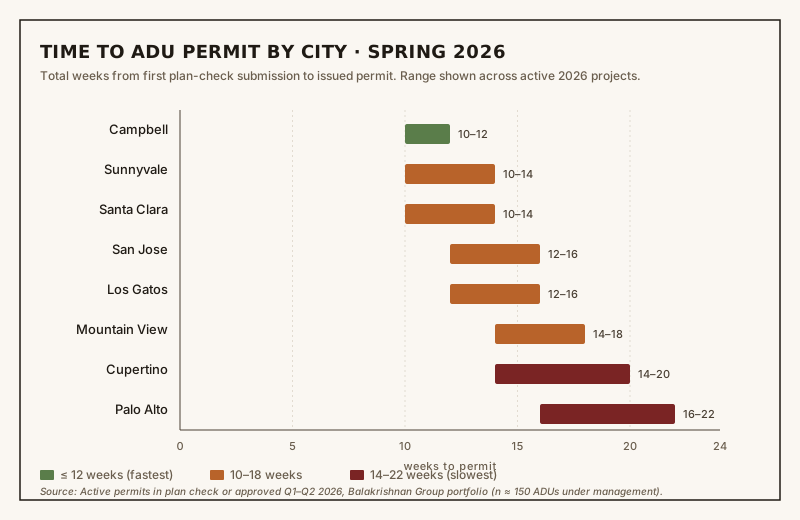
Here's a snapshot from active projects I have in plan check or recently approved this spring:
| City | First plan-check turnaround | Total time to permit | Notes |
|---|---|---|---|
| San Jose | 4-6 weeks | 12-16 weeks | Universal Permit available for prebuilt models |
| Sunnyvale | 3-5 weeks | 10-14 weeks | Pre-approved plan library is the fastest route |
| Santa Clara | 4-6 weeks | 10-14 weeks | Smaller queue than San Jose, cleaner process |
| Mountain View | 5-7 weeks | 14-18 weeks | Recent reach code adds review steps |
| Palo Alto | 6-10 weeks | 16-22 weeks | Historic district overlays add weeks |
| Cupertino | 5-8 weeks | 14-20 weeks | Strict Title 24 review on first pass |
| Campbell | 4-5 weeks | 10-12 weeks | Quietly one of the most efficient |
| Los Gatos | 5-7 weeks | 12-16 weeks | Smaller staff, but they pick up the phone |
These are real numbers from active projects, not what the cities advertise. The advertised timelines on every city's website are shorter than what I'm watching happen on real applications.
Why the gap
A few things are stretching timelines this spring beyond what was happening in 2024.
The 2025 Energy Code transition. Plan check teams are still working through the late-2025 submissions that need to be re-reviewed against the new code: solar, heat pump space heating, plug load controls. I covered the 2025 Energy Code cost impact on ADU builds separately. The same code change driving up build costs is also slowing down plan check.
Reach code adoption. Mountain View, Sunnyvale, Cupertino, Palo Alto, Menlo Park, and Los Altos all updated their reach codes in 2024 or 2025. Plan checkers are still calibrating against the new requirements, and that means more first-pass corrections.
Staffing. Two cities I work with have lost senior plan checkers since fall 2025. Replacements are still ramping. I won't name names, but if your project landed on a junior checker for the first review, expect more rounds.
Solar interconnection coordination. PG&E's interconnection backlogs have spilled into city plan check for projects that share a service. Several plan checkers now hold approvals until they have confirmation PG&E can energize the new load, which adds 2-4 weeks.
Pre-approved plans are the cheat code
Sunnyvale, San Jose, Mountain View, and a handful of other cities now offer pre-approved ADU plan libraries. You pick a plan from the city's catalog (or from a state-approved vendor like California's HCD pre-approved program), and plan check runs in roughly half the time. I've watched Sunnyvale issue permits on a pre-approved plan in 4-5 weeks total, soup to nuts.
The trade-off: the plans are stock. You can't move walls around, can't add custom finishes that change the structural layout, can't reshape the footprint. For a homeowner who wants a 700-square-foot two-bedroom in a roughly rectangular footprint, this is a great fit. For someone with a weirdly shaped lot or a desire for vaulted ceilings and oversized windows, custom is still the path.
The HCD escalation lever
If a city is sitting on your permit past the 60-day window after your application is technically complete, you have a real escalation path. California's Department of Housing and Community Development tracks ADU permit complaints and has issued letters to cities that are systematically slow. Two of my clients have used this in the past 18 months, and both got their plan check moved up after a letter.
Two caveats. First, this works better for clear violations of the 60-day rule, where you have documentation that your application was complete and the clock was running. It's less effective when the city says you're still in corrections. Second, the relationship matters. If you're going to keep working with that city for a future build, picking a fight on permit #1 might create friction on permit #2.
What's actually working this spring
The owners I see breaking ground on schedule are doing three things.
They submit clean. They pay an experienced ADU designer or architect to put together a complete package: structural calcs, energy compliance, site plan, drainage, electrical load calc, all in one go. The first plan check round comes back with minor corrections instead of a 14-page red-line.
They file the PG&E service application the same week they file the building permit. Energy upgrades and new service drops are running 12-20 weeks in most cities. If you wait until framing is up to apply, you'll finish framing and sit there. That advice got more urgent in September, when PG&E said it would defer new housing connections as part of a $2 billion spending cut.
They pick the city's preferred path. If your lot fits a pre-approved plan, take it. If you want a junior ADU (under 500 square feet, attached to the main house), the streamlined JADU process is faster than a detached ADU.
What to do this month if you want to break ground in 2026
If you haven't filed yet:
- Get plans drawn and ready for first submittal by end of June if you want a permit before Halloween
- Pull the city's reach code and ADU checklist before your designer finalizes plans
- File the PG&E service application the same day you submit for the building permit
If you're mid-corrections:
- Get the corrections back to plan check within a week, not three. Every week you sit on corrections is a week the queue advances around you.
- Call the plan checker if you have a question. Most of them will pick up. The phone is faster than email.
If your permit is past the 60-day mark and the city is unresponsive:
- Document that your application was complete. Confirm in writing that the city accepted the package.
- File a complaint with HCD as a last resort, and only after a polite escalation up the city's planning chain.
The state has been pushing on cities to speed up. The 2026 ADU laws I covered earlier this year added more teeth. The front-line experience is still uneven, and the difference between a 10-week permit and a 22-week permit is real money on construction loans, lost rental income, and the patience of your contractor. The same is true at the other end of the build: what fails at final inspection is where owners lose another two to four weeks they didn't budget for.
If you're trying to figure out which city's permit pipeline gives you the best shot at breaking ground this summer, request a free ADU rental analysis and I'll share what I'm seeing on similar lots in your area. Twelve years of South Bay ADU work, and the timelines I'm sharing are from active permits this spring.
Sources
- California Government Code Section 65852.2 — California Legislative Information
- HCD Accessory Dwelling Units — California Department of Housing and Community Development
- HCD Pre-Approved ADU Plans — California Department of Housing and Community Development
- San Jose ADU Permit Center — City of San Jose
- Sunnyvale Pre-Approved ADU Plans — City of Sunnyvale
- California Reach Codes — Statewide Reach Codes Collaborative
Ready to manage your ADU?
Get a free rental analysis. Three-day turnaround. No obligation.
Request a Free Analysis →