How to Legalize an Unpermitted ADU in the Bay Area: The 2026 Guide
AB 2533 changed the game for unpermitted ADUs built before 2020. I walk through the actual legalization process, what it costs, where cities differ, and the mistakes that delay people by months.
I get calls about unpermitted ADUs almost every week. A homeowner converted their garage in 2016. Or they built a backyard cottage in 2018 and never pulled permits. Now they want to rent it out, or they're selling the house and the buyer's inspector flagged it, or they just got a notice from code enforcement.
The conversation usually starts with some version of: "Am I screwed?"
No. You're not. California passed AB 2533 in 2024, and it took effect on January 1, 2025. It created a real, workable legalization path for unpermitted ADUs built before January 1, 2020. Not a loophole. Not a "maybe." A protected permitting channel with actual teeth.
But it's not automatic. You still need to apply, submit plans, and fix safety issues. The law shifted the test from "does your unit meet every current building code?" to "can it be made safe?" That's a big difference, and it's the reason legalization is now realistic for most Bay Area homeowners sitting on an unpermitted unit.
Let me walk you through exactly how it works.
What AB 2533 actually does
Here's the short version: if your ADU or JADU was built before 2020, your city can't deny your legalization permit just because the unit doesn't meet current ADU zoning rules or modern building standards. They can only deny if corrections are needed to address "substandard conditions" under Health and Safety Code Section 17920.3. That's the state's baseline life-safety standard: working plumbing, safe electrical, proper egress, smoke and CO detectors, weather protection, ventilation.
The law also says your city can't punish you for having the unpermitted unit once you apply to legalize it. That's a big deal. A lot of homeowners have avoided legalization because they were afraid of fines or a demolition order. AB 2533 takes that fear off the table for qualifying units.
One more thing worth knowing: the law lets you hire a licensed inspector for a confidential third-party inspection before you even submit your application. That means you can find out exactly what needs to be fixed without the city knowing about it yet. Think of it as a practice test.
AB 2533 does not eliminate permit fees. You'll still pay plan check and building permit fees. What it restricts are impact fees and certain connection charges that cities used to pile on as a way to punish unpermitted construction.
The legalization process, step by step
I've mapped out the full process based on how it actually works across Santa Clara and San Mateo County cities. Here's the flowchart:

Let me break down each step.
Step 1: Figure out your jurisdiction and confirm eligibility. Are you in a city or unincorporated county? The permitting authority changes. Then confirm the unit was built before January 1, 2020. Gather whatever proof you have: old permits (even partial ones), assessor records, utility bills from that period, dated photos, contractor invoices. The more documentation, the smoother this goes.
Step 2: Get a confidential pre-inspection. I always recommend this. AB 2533 requires cities to tell you that this option exists, but they don't exactly advertise it. Hire a licensed contractor to inspect the unit and tell you what would fail a Health and Safety Code 17920.3 review. You'll know the full scope of work before you commit to anything.
Step 3: Prepare as-built plans. You need a designer or architect to draw the unit as it currently exists, plus the proposed safety upgrades. This includes a site plan, floor plans, elevations, and Title 24 energy compliance documentation. Projects filed in 2026 must use the 2025 California Building Standards Code, which took effect January 1.
Step 4: Submit your permit application. Under SB 543, which took effect January 1, 2026, agencies must issue a completeness determination within 15 business days. If they don't respond, your application is automatically deemed complete. But here's the catch: several cities (Redwood City is a notable one) won't even accept an incomplete application, which means the 15-day clock never starts. Get your package right the first time.
Step 5: Plan check and parallel permits. While the building department reviews your plans, you may need parallel permits for fire sprinklers, public works, excavation, or stormwater. Mountain View publishes 2-week review cycles for ADU legalization. Other cities vary.
Step 6: Construction and safety upgrades. This is where the real work happens. Fix whatever the inspector flags: electrical issues, plumbing problems, missing egress windows, inadequate ventilation, structural concerns. The scope depends entirely on how the unit was originally built.
Step 7: Inspections. The city inspector verifies your upgrades are done correctly. Depending on the scope of work, you may need multiple stage inspections (rough electrical, rough plumbing, framing, final).
Step 8: Final sign-off. You get your certificate of occupancy. The unit is now legally permitted. You can rent it for terms of 30 days or longer. And a permitted ADU rents for more than an unpermitted one, full stop.
What it costs
I'm not going to give you a single number because there isn't one. A garage conversion where the electrical is mostly fine and you just need egress windows and smoke detectors is a completely different project from a detached unit with unpermitted plumbing and no proper foundation.
Here's what the cost ranges actually look like across the Bay Area:
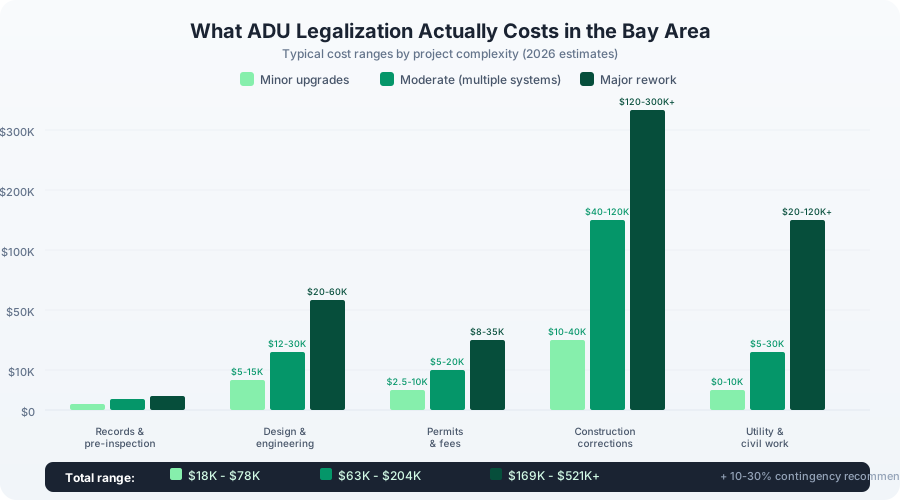
For a minor legalization (the unit is mostly solid, just needs safety upgrades), you're looking at $18,000 to $78,000 all in. For a moderate project where multiple systems need correction and maybe some structural work, $63,000 to $204,000. For a major rework involving utility trenching, foundation issues, or significant structural repair, $169,000 to over $500,000.
The biggest cost bucket is almost always construction corrections. That's 50 to 60 percent of the total budget for most projects. Design and engineering runs 15 to 20 percent. Permits and agency fees are typically 10 to 15 percent.
Some published fee references to ground this: Mountain View's permit fees for preapproved ADUs run $7,000 to $13,000. San Mateo County charges $892 just for a geotechnical review on ADUs. Palo Alto's building permit fees alone can range from $2,000 to $8,000, and impact fees push it much higher. Add 10 to 30 percent contingency to whatever number you land on. Concealed conditions behind walls are the norm, not the exception, in unpermitted construction.
Where cities differ (and where they trip you up)
State law sets the baseline, but the city you're in determines how much friction you'll actually face. Here's what I've seen across the major Bay Area cities:
San Jose has a dedicated "ADU Ally" contact and a structured process, but projects get delayed constantly by missing water flow documentation. If you're in San Jose, get your fire and water supply paperwork started the same week you start your plans. Don't wait.
Mountain View is one of the more predictable cities. They publish 2-week review cycles for legalization plan review. Their preapproved ADU program advertises a 30-day path to permit with a 7-business-day prescreen. If your unit fits a preapproved template, you can move fast here.
Sunnyvale publishes AB 2533 guidance and offers deferred enforcement while you work through the legalization process. They've posted a "substandard dwelling definition" document that spells out exactly what they'll check.
Palo Alto is expensive. Fees can stack up quickly, and if your property falls in a flood zone or historic district, you're dealing with additional overlay requirements. Budget accordingly.
Santa Clara (city) has some discretionary review triggers for historic properties that can slow things down. If your home has any historic designation, plan for extra steps.
Redwood City is thorough but strict. They won't accept incomplete applications, and their fire flow test takes about 4 weeks. Their completeness checklist is worth reading before you start, because if you're missing items, you don't get shot-clock protection.
San Bruno publishes 3 to 4 weeks for initial review and 1 to 2 weeks for subsequent reviews. They require surveys for structures near property lines, which is common with unpermitted builds that went right up to the setback.
City of San Mateo is on the easier end. ADUs are generally treated as ministerial, so no planning application is needed if you meet objective standards. Just the building permit.
For homeowners in unincorporated Santa Clara County, there's a formal AB 2533 legalization program with a published code enforcement delay: they'll pause enforcement penalties for up to 5 years while you work through the process. San Mateo County ran a pilot amnesty program from 2019 to 2022, but that's discontinued. You go through the standard ADU permit process now with AB 2533 protections.
The mistakes that cost people months
Incomplete applications. This is the number one avoidable delay. Multiple cities explicitly warn that incomplete submissions won't be accepted and don't benefit from state timeline protections. Get the full checklist from your city before you submit anything.
Waiting on fire and water documentation. San Jose and Redwood City both flag this as a top delay driver. Fire flow tests and water flow letters take weeks to obtain. Start them early.
Not budgeting for concealed conditions. Your unit looks fine from the outside. Then you open a wall and find knob-and-tube wiring, or a sewer lateral connected with rubber couplings instead of proper fittings. AB 2533 checklists explicitly note that "concealed conditions may require exploratory opening." Plan for it.
Assuming preapproved plans will work. Preapproved ADU plans can save time, but they're for new construction. If you're legalizing an existing unit, your as-built conditions probably don't match any preapproved template. Daly City's planning department states this explicitly: modifications to preapproved plans are not permitted, so if your existing unit doesn't match, you lose the expedited path.
Ignoring the 2025 code cycle. Applications filed in 2026 must comply with the 2025 California Building Standards Code, including the 2025 Energy Code. Some homeowners and even some designers are still referencing the prior code cycle. Make sure your plans are current.
New laws that matter in 2026
Beyond AB 2533, a few other pieces of legislation affect your legalization project this year. I covered the full list in our breakdown of the 2026 California ADU law changes, but here are the ones most relevant to legalization:
SB 543 added the 15-business-day completeness determination requirement and clarified impact fee thresholds using "interior livable space" (750 sq ft for ADUs, 500 sq ft for JADUs). If your unit is under those thresholds, you may be exempt from certain impact fees.
AB 1154 changed JADU owner-occupancy rules. If your JADU has its own separate bathroom, the owner-occupancy requirement no longer applies. If it shares a bathroom with the main house, you still need to live on the property.
AB 462 created a 60-day approval clock for coastal development permits for ADUs. If you're in a coastal zone (parts of the Peninsula), this limits how long the process can drag on.
AB 1033 allows cities to let ADU owners sell the unit as a separate condo. Not all Bay Area cities have adopted this yet, but it's expanding. Worth asking your planning department about.
Why bother legalizing?
I'll be direct: a permitted ADU is worth more than an unpermitted one in every way that matters. It rents for more because you can list it openly on the market. It adds real equity to your property at sale. It's insurable. It protects you from code enforcement action. And if something goes wrong (a tenant injury, a fire, a flood), your liability exposure with an unpermitted unit is enormous.
The rent premium alone usually justifies the legalization cost within a few years. A permitted one-bedroom ADU in San Jose rents for $2,500 to $3,000 a month. An unpermitted unit rented under the table? You're taking a discount and accepting all the risk. Once your unit is permitted, our complete guide to renting out your ADU covers everything from pricing to tenant placement.
City resources and contacts
Here are the official ADU and legalization pages for the cities and counties I referenced in this post. Bookmark the one for your jurisdiction before you start:
San Jose ADU resources — includes their "ADU Ally" contact for direct help.
Mountain View ADU permits — preapproved plans and published timeline estimates.
Sunnyvale ADU information — AB 2533 guidance and deferred enforcement info.
Palo Alto ADU guidebook (PDF) — fee ranges and overlay requirements.
Redwood City ADU permits — completeness checklist and fire flow lead times.
Santa Clara County ADU legalization — AB 2533 program with code enforcement delay.
San Mateo County ADU permits — standard process with AB 2533 protections.
California HCD ADU handbook — the statewide reference, updated for 2026.
If you have questions about your current ADU situation, call me at (408) 813-8001. I can connect you with a licensed general contractor to do a confidential third-party audit of your unit.
Ready to manage your ADU?
Get a free rental analysis. Three-day turnaround. No obligation.
Request a Free Analysis →